
Non-blocking fabric
Leaf-spine with 400G uplinks and RoCEv2 on the compute plane. Oversubscription is stated in the design document you receive, not discovered in a benchmark.
Start with the workload: model class, memory footprint, concurrency and deployment timing. Then engineer the cluster around what the model actually needs — not around a reference configuration.
Platform tiers
Two tiers in service today, a third on the way. We will tell you when the smaller one is the correct answer — a benchmark you can repeat beats a larger invoice.
Tier 01 · Universal
Server Edition · 96 GB per GPU
Ninety-six gigabytes holds a 70-billion-parameter model in FP8 on a single card, which takes tensor parallelism out of the serving path. The same part carries a full ray-tracing pipeline and a four-encode, four-decode media engine, so an inference tenant and a render tenant can share one fleet without either noticing the other.
It is the default tier for inference, visual computing and agent workloads that need to stay in the region.
The absence of NVLink is a design boundary, not a defect. It rules out tensor-parallel splitting of very large models across a node. It does not affect rendering, one-model-per-GPU serving or pipeline-parallel serving.
Tier 02 · Frontier
192 GB HBM3 per GPU
The frontier tier exists for workloads that must spread one model across many devices with very high inter-device bandwidth: large-scale pre-training, tensor-parallel inference and HPC. Where Tier 01 is partitioned, this one is coupled.
Deployed at site level with liquid-assisted thermal, because 750 watts per device does not belong in a hall designed for 600.
Reserved for jobs where the binding constraint is the interconnect rather than memory per card. If a workload fits comfortably on one RTX PRO 6000, it belongs on Tier 01 — and we will say so.
Tier 03 · NVLink coupled
Blackwell Ultra · coming soon
The third tier couples eight Blackwell Ultra GPUs over NVLink inside a single HGX node, for training and tensor-parallel workloads whose binding constraint is NVLink-class bandwidth rather than memory per card.
Availability will be published in the compute capacity inventory as blocks are committed. The first blocks are allocated against signed reservations, so register the workload early if this tier is the design centre.
Tier 03 is not yet in service. Specifications are stated at platform level and confirmed per deployment at reservation.
Facility
Power and cooling ship inside the module instead of being retrofitted around it. That single decision is what keeps a deployment on schedule.
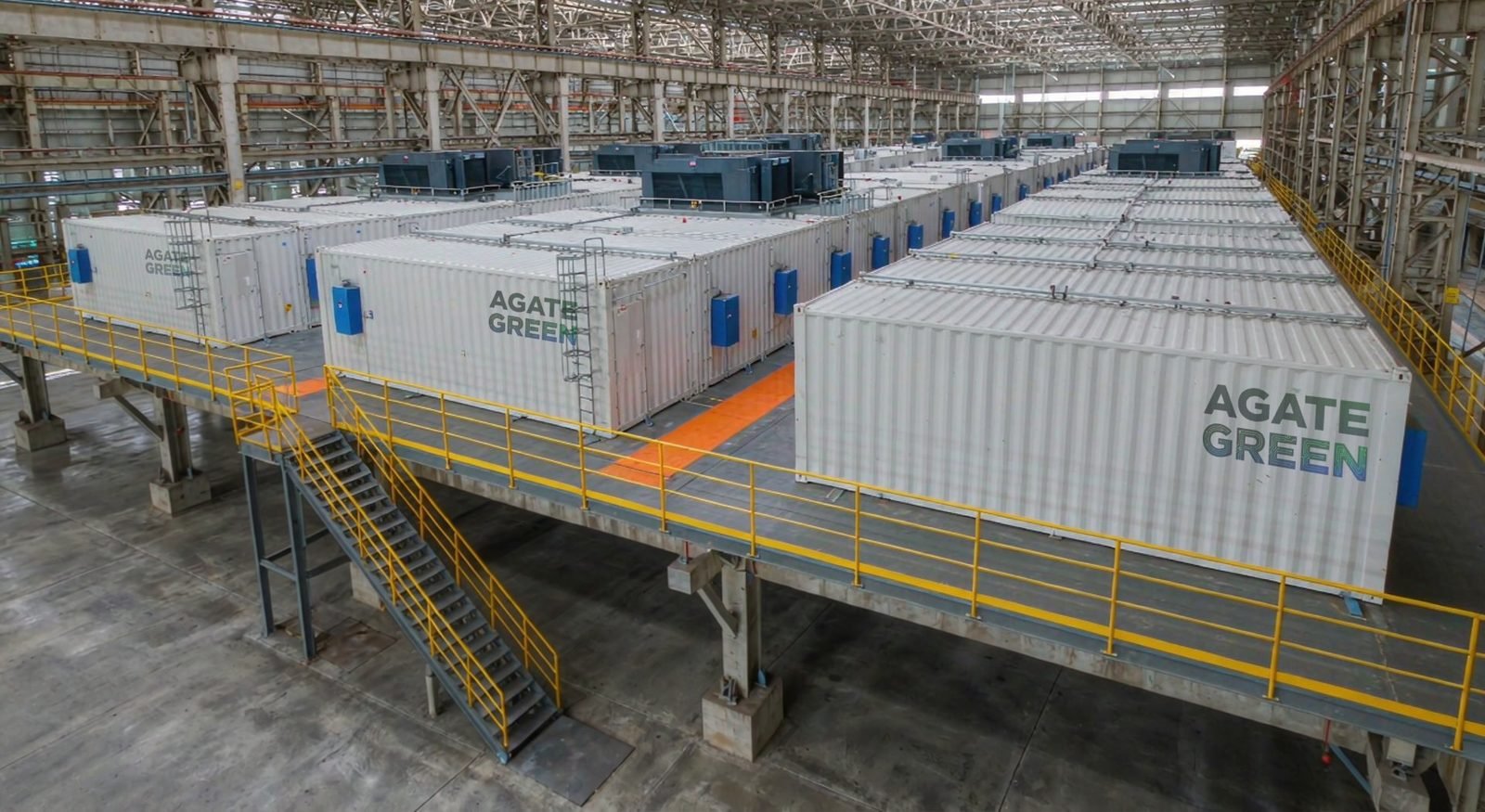

A conventional hall is built, then commissioned, then filled. A modular hall is commissioned in a factory, shipped complete, and filled. The critical path shortens because the electrical and mechanical tests are no longer waiting on a building.
It also means capacity can be added in blocks that match a tenant's ramp instead of a landlord's financing cycle.
Fabric & software
Compute is only as useful as the network, storage and scheduler around it. All three are specified per deployment, not inherited from a template.
Leaf-spine with 400G uplinks and RoCEv2 on the compute plane. Oversubscription is stated in the design document you receive, not discovered in a benchmark.
NVMe tiers sized to the checkpoint and dataset working set, with an object tier behind them for artefacts and model weights.
Slurm or Kubernetes, per-tenant quotas, and metering that reconciles to the invoice without a support ticket.
Operations
A cluster is an operating commitment. These are the four things we hold ourselves to once the workload is live.
01
GPU, fabric and facility telemetry in one view, with alerting agreed before go-live rather than after the first incident.
02
On-site spares and engineers in the region. Component replacement is a site visit, not an international shipment.
03
Dedicated clusters with tenant-scoped keys. Your data does not share a scheduler with another customer unless you ask for it.
04
Consumption per site and per workload, with the measurement boundary stated alongside every efficiency figure.
Questions
No. The smallest unit is a node — eight GPUs on one host — because the serving topology, fabric and power budget are designed around the node. MIG partitioning is available inside a node if you need smaller slices.
Both, but on different tiers. Tier 01 is built for inference and visual computing. Large-scale pre-training belongs on the MI300X tier, where the interconnect is the design centre.
In the country of the site you contract. Malaysia has multiple locations that can be offered, subject to agreement and contract. We do not replicate customer data across borders without a written instruction.
Yes — that is the default commercial model. Dedicated clusters carry their own keys, quotas and maintenance window, and are priced against a defined term.
You send the model and a representative request mix. We run it on the target hardware and return latency, throughput and tokens per watt measured on our estate. It is the same figure you will see in production.
Send the workload, the model class and the latency target. We come back with a reference configuration — and a measured benchmark on the target hardware before you commit.